130 Years of Nové Lázně
Ceremonially opened on 1 June 1896 — a jewel of spa architecture designed by Marienbad-born Josef Schaffer after Italian Renaissance models. Today the largest historical balneotherapy facility in the Czech Republic with the Roman Baths, the Royal Cabin of Edward VII and a mineral spring right in the corridors.
We have prepared the very best for you
Celebrate 130 years of Nové Lázně with special packages that combine history, healing and an unforgettable experience.
Anniversary Stay — weekend experience
A short stay with access to the Roman Baths, a carbonic bath and a drinking cure. Perfect for an extended weekend.
View offer →Anniversary Stay — complete spa week
A week-long programme with full spa care, the Royal Cabin, treatments and a medical consultation.
View offer →Treasures you won't find anywhere else
Roman Baths from 1896
The glazed ceiling floods the interior with soft daylight. The vault is supported by twenty-one soaring columns of dark-red Salzburg marble with capitals of white Carrara stone. Two original mineral-water pools, gilded gargoyles in the shape of lion heads and coloured tiles evoke the grandeur of ancient baths. A third pool with a counter-current was added during the modern reconstruction.
Royal Cabin of Edward VII
A private bathing room built for the British king. The doors to the loggia are adorned with original painted glass from the famous Tyrolean Geyling workshop, which shimmer in every colour in the sunlight. The tiles are luxurious majolica and paintings of birds hang on the walls — the setting was meant to evoke the atmosphere of a garden pavilion. A wooden chair with a built-in mechanical scale still stands in the cabin today.
Imperial Cabin of Franz Joseph I
A bathing room with original historical décor, reserved for the Austrian emperor. Both cabins — the Royal and the Imperial — are used today for specialist balneotherapy treatments, mineral baths and mud wraps.
5,900 m² interconnected complex
Nové Lázně, Centrální Lázně, Maria Spa, Hvězda, Neapol and Imperial are joined into a single whole by covered promenades and corridors. Guests move between the buildings without stepping outside — the largest historically original spa complex in Bohemia.
Josef Schaffer — a native of Marienbad
The impetus for the creation of Nové Lázně came from Abbot Alfred Clemens, who decided on its construction, secured the financing and gave the project a clear vision. His initials A.C. and A.T. (Abbas Teplensis) are still carved into the building's pediment.
The architectural design was drawn up by Marienbad-born Josef Schaffer. He drew inspiration during his travels through Italy — particularly in Venice, Bologna and Florence. Elements of the Italian Renaissance lent the building its magnificent and timeless character. Construction took four years and always took place in winter outside the main season so as not to disrupt the spa operations. The ceremonial opening took place on 1 June 1896.
Nové Lázně is today the largest historical balneotherapy facility in the Czech Republic. The Forest Spring and Ambrose Spring are piped directly into the building and form the foundation of comprehensive spa care, rehabilitation and modern diagnostics, including oxygen therapy. Marienbad has been part of the UNESCO World Heritage since 2021 and has held climatic spa status since 2023.
Milestones of Nové Lázně
The first spa season
Eighty guests arrived in the inhospitable landscape. Paved roads and basic services were lacking — guests brought their own beds and food supplies. Even so, the mineral springs were rapidly gaining renown.
An era of innovation
Steam and shower baths are introduced, followed shortly by peat wraps and gas baths using the carbon dioxide of the Maria Spring — a treatment still considered a local speciality today.
The birth of the Neubad
Abbot Karl Kašpar Reitenberger founds a new bathhouse — the Neubad. Sixteen bathing cabins and ten guest rooms for visitors arriving to take the iron-rich waters of the Ambrose and Caroline springs.
The first expansion
The number of bathing cabins grows to 14, and a separate boiler house is built beside the building. A Kursaal hall is added — Nové Lázně becomes the social centre of the town.
Arrival of the first train
Thanks to the railway, the town opened up to Europe and visitor numbers surged. Existing capacities were no longer sufficient, and a major reconstruction became necessary.
The "steel baths"
The old Nové Lázně had 42 cabins for so-called steel baths (Stahlbäder) — a bath in the Ambrose Spring. The water was so iron-rich that it stained the tub rust-red and promised patients "steely health".
Schaffer's reconstruction
Abbot Alfred Clemens decided on the reconstruction, secured the financing and gave the project a clear vision. His initials A.C. and A.T. (Abbas Teplensis) are still carved into the building's pediment. Architect Josef Schaffer, a native of Marienbad inspired by his travels to Venice, Bologna and Florence, transformed the Neubad into a monumental Neo-Renaissance palace. Construction took four years and always took place in winter so as not to disrupt the spa operations. The ceremonial opening took place on 1 June 1896.
King Edward VII's first visit
The future British monarch arrives and immediately falls in love with the town. A private Royal Cabin is created for him at Nové Lázně — the doors to the loggia are adorned with original painted glass from the famous Tyrolean Geyling workshop, the tiles are luxurious majolica and paintings of birds hang on the walls. The setting was meant to evoke the atmosphere of a garden pavilion amidst nature.
A meeting of two monarchs
On 16 August 1904, Emperor Franz Joseph I and King Edward VII meet at the hotel for an official diplomatic conference. For one day, Marienbad becomes the centre of European politics.
Founding of the Royal Golf Club
Edward VII founds the oldest golf club in Bohemia — the Royal Golf Club Mariánské Lázně. The club has operated continuously to this day.
Expansion under Abbot Helmer
Under the leadership of Abbot Gilbert Helmer, the capacity of bathing cabins nearly doubles. Nové Lázně responds to the growing demand of the international aristocracy.
The royal tradition continues
Prince Edward, Earl of Wessex, stays at the hotel, continuing the tradition of the British Royal Family in Marienbad.
Inscription on the UNESCO List
Marienbad becomes part of the transnational inscription "The Great Spa Towns of Europe". Nové Lázně is among the key buildings of the protected zone.
Climatic spa status
Marienbad is awarded the status of a climatic spa — confirmation that the local microclimate is itself a healing resource.
130 years since the ceremonial opening
On 1 June 2026, Nové Lázně celebrates its 130th anniversary. The building still serves as a five-star spa hotel — the largest historical balneotherapy facility in the Czech Republic, with the original Roman Baths, the Royal Cabin and the Imperial Cabin in full operation.
Fascinating facts from history
Stories and facts from 130 years of Nové Lázně — drawn from the archives of the Hamelika journal, the Mariánské Lázně Municipal Museum and the period press.
The initials A.C. and A.T. (Abbas Teplensis) are still carved into the building's pediment — a reminder of Abbot Alfred Clemens, who initiated and financed the reconstruction.
The vault of the Roman Baths is supported by 21 soaring columns of dark-red Salzburg marble with capitals of white Carrara stone. Gilded gargoyles in the shape of lion heads complete the atmosphere of ancient baths.
The doors to the loggia in the Royal Cabin are adorned with original painted glass from the famous Tyrolean Geyling workshop. They shimmer in every colour in the sunlight — the cabin was meant to evoke a garden pavilion amidst nature.
A wooden chair with carved legs stands in the Royal Cabin, with a mechanical scale concealed inside. Edward VII used it to discreetly check his weight — standing on an ordinary scale would not have befitted a king.
In the first spa season of 1808, around 80 guests arrived in the inhospitable landscape. Roads and services were lacking — guests brought their own beds and food supplies.
Before Schaffer's reconstruction, the old Nové Lázně offered 42 cabins for "steel baths" (Stahlbäder). The water of the Ambrose Spring was so iron-rich that it stained the tub rust-red.
The Ferdinand Spring was piped to Nové Lázně through a 1,700-metre conduit from Úšovice. A steam engine pushed the water along a route climbing 43 metres in elevation.
Edward VII travelled to Marienbad nine times in 12 years. The European press called the town "the summer capital of European diplomacy".
As early as 1820, steam and shower baths were introduced here, followed shortly by peat wraps and gas baths using CO₂ from the Maria Spring — a treatment unique to this day.
The nine visits of King Edward VII
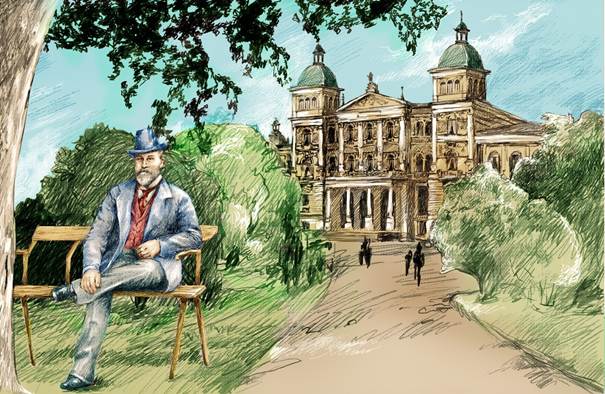
When the British Crown Prince (and future King) Edward VII first arrived in Marienbad in 1897, he fell in love with the town at once. Over the following twelve years he returned nine times — and on every occasion Nové Lázně was his base.
His daily ritual never varied: a morning drinking cure at the Cross Spring, then the move to Nové Lázně and a bath in the private Royal Cabin. An opulent belle époque bathtub still stands inside it, and beside it a remarkable piece of furniture — an elegant wooden chair with a built-in mechanical scale. The king used it to discreetly check his weight without having to stand on an ordinary scale.
Thanks to his regular sojourns, Marienbad became the summer capital of European diplomacy. The culmination was the meeting with Emperor Franz Joseph I on 16 August 1904 — an event commemorated today by a bronze sculpture group on Goethe Square.
In 1905, Edward VII founded the Royal Golf Club Mariánské Lázně — the oldest golf club in Bohemia, in continuous operation to this day. And the royal tradition continues: in 2005, Prince Edward, Earl of Wessex, stayed at Nové Lázně.
"The Royal Cabin, with its original bathtub, resting room and chair with a built-in scale, is a living testament to the era when the history of Europe was being written in Marienbad."
Experience history for yourself
Bathe in pools with marble columns from 1896, try a mineral bath in the Royal Cabin of Edward VII, and taste spring water right in the corridors of the hotel.
Historical information sourced from Mariánské Lázně Annals (Hamelika), History Summary (Hamelika) and Ensana Hotels.