From Forest Clearing to World Stage
The story of Mariánské Lázně is one of the most remarkable in European urban history. In 1786, the site of today's elegant spa town was little more than a boggy clearing in the Slavkov Forest, known only to local monks and a handful of farmers who used the strange-smelling mineral streams to water their cattle. Within fifty years, it had become one of the most fashionable destinations on the continent — a place where kings, composers and literary giants came to take the waters, to think and to be seen.
The Discovery of the Springs
The mineral springs of the Marienbad valley had been known in a general way for centuries. The Premonstratensian monks of nearby Teplá Monastery recorded their existence as early as the sixteenth century, and local people had long attributed curative properties to the waters. But it was not until the late eighteenth century that science caught up with folklore.
In 1779, the monastery physician Dr. Josef Nehr began systematically analysing the springs' mineral content. His findings were extraordinary: the valley contained dozens of distinct springs, each with a unique chemical profile and potential therapeutic application. Nehr spent decades advocating for the development of the site, and in 1818, with the support of Abbot Karl Kaspar Reitenberger, Marienbad was officially declared a public spa town.
The Golden Age (1820s–1914)
What followed was a period of astonishing growth. Under the enlightened guidance of Abbot Reitenberger and the horticultural genius of Václav Skalník — who transformed the marshy valley into a landscape park of European significance — Marienbad rapidly acquired the grand hotels, colonnades, churches and cultural institutions that define it to this day.
By the mid-nineteenth century, Marienbad was firmly established among the great spa towns of the Habsburg Empire, rivalling Karlsbad (Karlovy Vary), Baden-Baden and Wiesbaden. Its guest registers read like a who's who of European civilisation.
Johann Wolfgang von Goethe
The great German poet and polymath visited Marienbad three times between 1821 and 1823. During his final visit, at the age of 74, he fell deeply in love with the 19-year-old Ulrike von Levetzow — an infatuation that produced one of his most celebrated poems, the Marienbader Elegie (Marienbad Elegy). The house where Goethe stayed is now a museum, and his presence remains woven into the fabric of the town.
Frédéric Chopin
The Polish composer visited Marienbad in 1836, where he was reunited with his compatriots and gave several private recitals. It was here that he deepened his acquaintance with Maria Wodzińska, to whom he would later propose. Chopin's connection to the town is celebrated each August during the Chopin Festival, one of the highlights of the cultural calendar.
King Edward VII
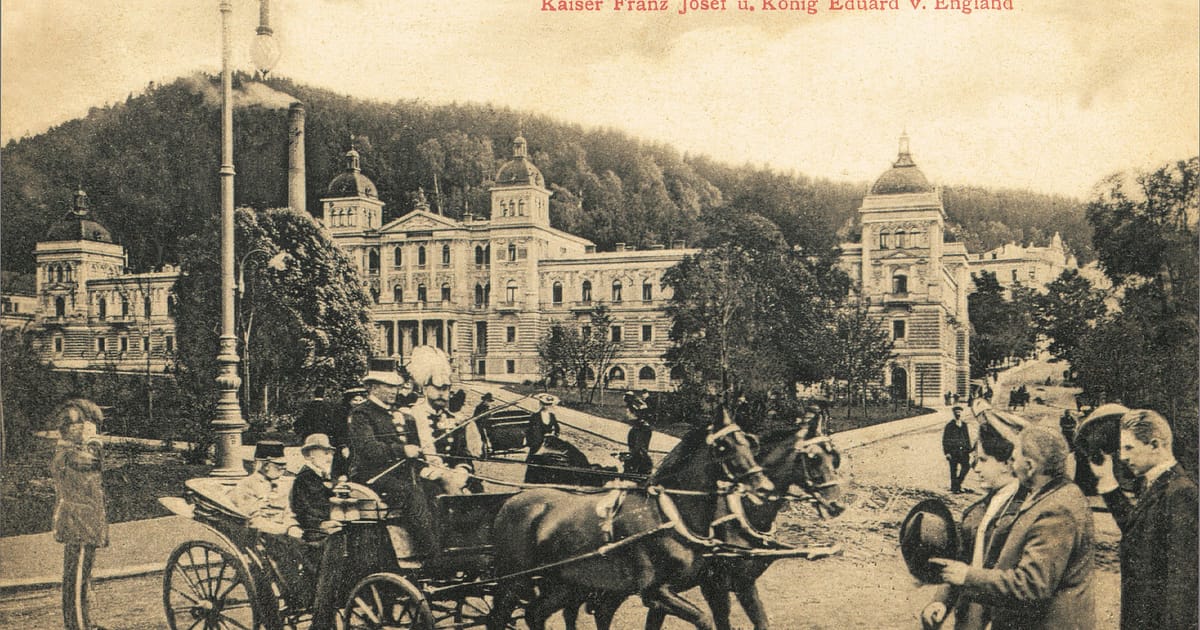
The British monarch was one of Marienbad's most devoted and conspicuous visitors, returning nine times between 1897 and 1909. Edward's visits brought international attention — and a retinue of diplomats, journalists and aristocrats. He founded the Royal Golf Club in 1905, the oldest in the Czech lands, and his presence helped cement Marienbad's reputation as a playground of the European elite.
Mark Twain
The American writer visited Marienbad in 1892 for his health and, characteristically, produced a witty account of the spa experience. His observations on the rituals of the drinking cure — the crowds at the springs, the earnest conversations about digestion, the mysterious porcelain cups — remain among the most entertaining things ever written about spa culture.
Franz Kafka
Kafka visited Marienbad in 1916, seeking relief from the tuberculosis that would eventually claim his life. His time in the town — quiet, contemplative, shadowed by illness — left traces in his letters and diaries. The contrast between Kafka's melancholic presence and the town's exuberant Belle Époque architecture is one of the more poignant threads in Marienbad's story.
"Marienbad is a place where one can fall in love again — with life, with nature, with the world." — Johann Wolfgang von Goethe, 1821
Architecture: A Living Museum
One of the great pleasures of visiting Marienbad is simply looking at the buildings. Because the town was built almost entirely during a single century of rapid growth (roughly 1815–1910), it possesses an unusual architectural coherence. The prevailing styles are Neoclassical, Second Empire and Art Nouveau, with occasional excursions into the Byzantine and the eclectic.
Key Architectural Highlights
- The Main Colonnade (1889) — A masterpiece of cast-iron construction, delicate as lace, stretching the length of the spa promenade. It was manufactured by a Blansko ironworks and is one of the finest structures of its kind in Europe.
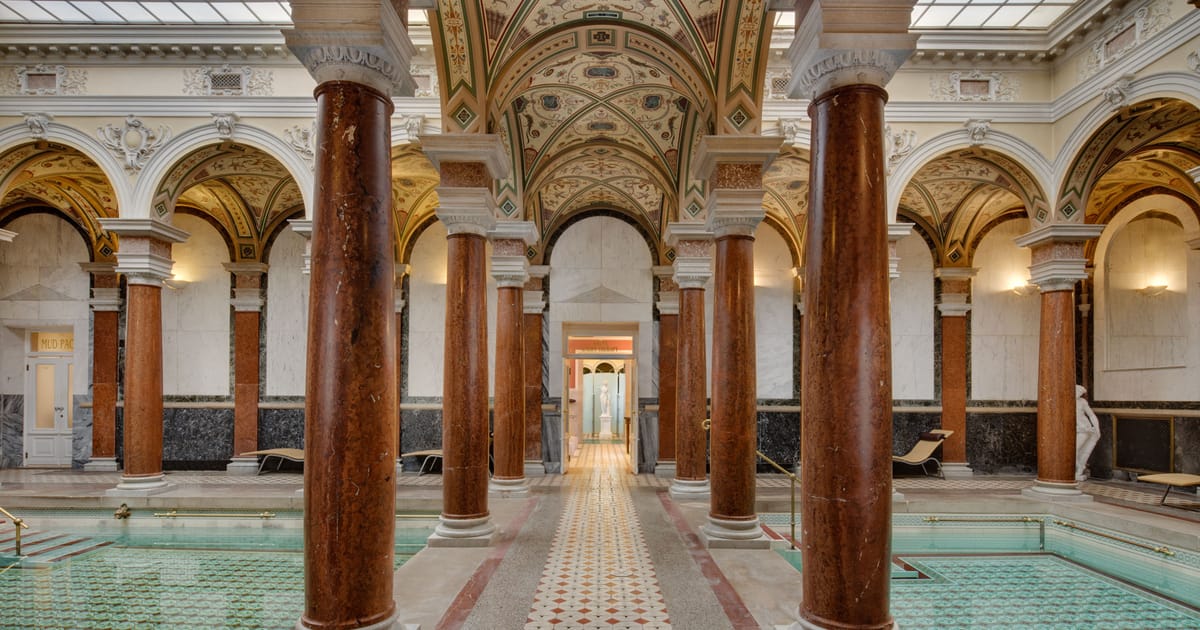
- The New Spa (Ensana Nové Lázně, 1896) — A monumental Neo-Renaissance bathhouse featuring the celebrated Roman Bath hall, with its ornate columns, mosaics and vaulted ceilings. Now part of the Ensana group, it remains one of the most architecturally significant spa buildings in Central Europe.
- Church of the Assumption (1848) — With its striking blue-and-white exterior and blend of Byzantine and Baroque Revival motifs, this hilltop church is one of Marienbad's most photographed landmarks.
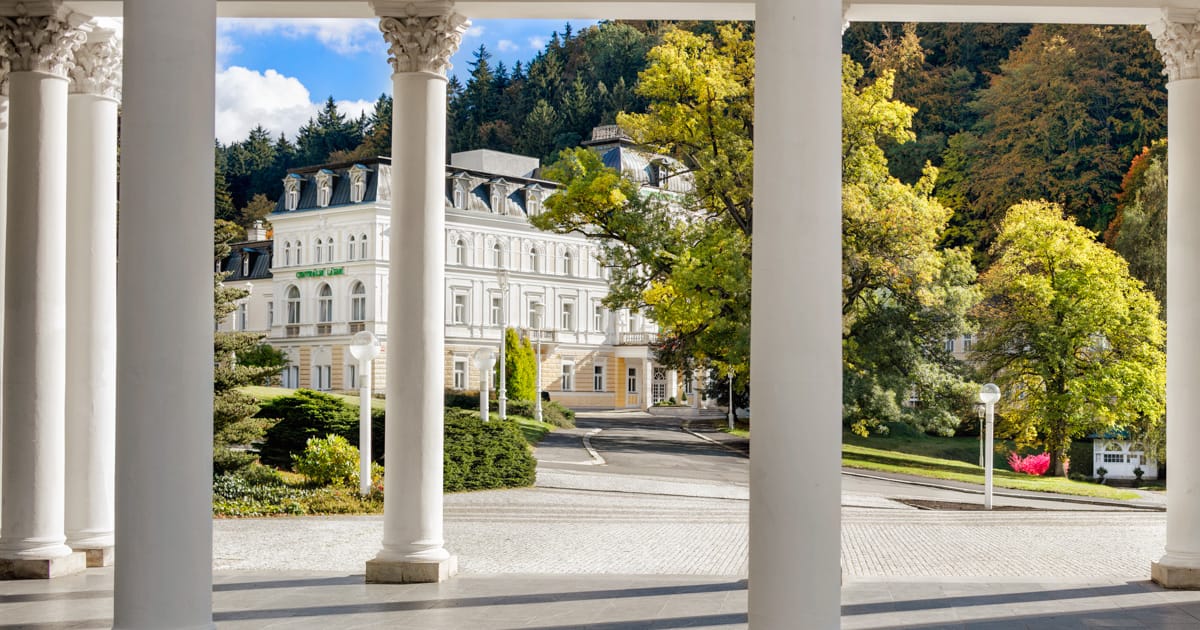
- Ensana Nové Lázně and Ensana Centrální Lázně — Grand spa hotels that have been continuously welcoming guests for well over a century, their facades a testament to the confidence and ambition of Marienbad's golden age.
- The Casino (1900) — An exuberant Art Nouveau building that now serves as a cultural centre, hosting concerts, exhibitions and social events.
The Twentieth Century: Upheaval and Renewal
The First World War brought Marienbad's golden age to an abrupt end. The collapse of the Habsburg Empire in 1918 placed the town in the newly formed Czechoslovakia, and the interwar period saw political tensions between the town's largely German-speaking population and the Czech state. After the Second World War, the German population was expelled under the Beneš decrees, and the town's character changed profoundly.
Under communist rule (1948–1989), Marienbad continued to function as a spa resort, but investment lagged and many buildings fell into disrepair. The Velvet Revolution of 1989 opened the door to restoration, and the decades since have seen a remarkable renewal. Historic buildings have been painstakingly restored, international visitors have returned in growing numbers, and the town has rediscovered its identity as a place of healing, culture and beauty.
UNESCO World Heritage Status (2021)
In July 2021, Mariánské Lázně was inscribed on the UNESCO World Heritage List as part of the transnational "Great Spa Towns of Europe" — a designation shared with ten other historic spa towns, including Bath, Baden-Baden, Karlovy Vary and Vichy. The inscription recognises the town's outstanding universal value as a testimony to the European spa culture that developed from the eighteenth century onwards: the interplay of natural springs, medical science, architecture, landscape design and social ritual.
For Marienbad, the UNESCO listing is both an honour and a responsibility. It affirms what visitors have felt for two centuries — that this is a place of exceptional significance — and it commits the town to preserving its heritage for generations to come.
Climatic Spa Designation (2023)
In 2023, Mariánské Lázně received the official designation of a Climatic Spa. This certification confirms that the town's natural environment — its pure air, elevation of 630 metres and the forest microclimate of the Slavkov Forest — meets strict criteria for climate therapy and constitutes a healing resource in its own right.
A Culture That Lives and Breathes
Marienbad's culture is not confined to museums and monuments. It is alive in the morning ritual of the drinking cure, in the sounds of the Singing Fountain at dusk, in the Chopin Festival each August, and in the simple pleasure of walking through a park designed two hundred years ago by a man who understood that beauty is a form of medicine. To visit Marienbad is to step into a story that is still being written.